Guided Diving Versus Self Guided in Punta Cana
Guided diving versus self guided in Punta Cana: compare safety, freedom, local knowledge, and cost to choose the right Caribbean underwater experience.
The choice between guided diving versus self guided diving can shape your entire Punta Cana vacation. One option gives you a local professional at your side, a planned route, and eyes on the conditions. The other promises independence and a more personal pace. Neither is automatically better, but the right choice depends on your certification, your comfort in unfamiliar water, and what you hope to see in the Caribbean Deep.
For many visitors, the question is not whether they can technically dive without a guide. It is whether they want to spend a precious vacation day managing logistics, navigation, and changing conditions - or simply enjoying the reef, wreck, and blue water around them.
Guided Diving Versus Self Guided: The Real Difference
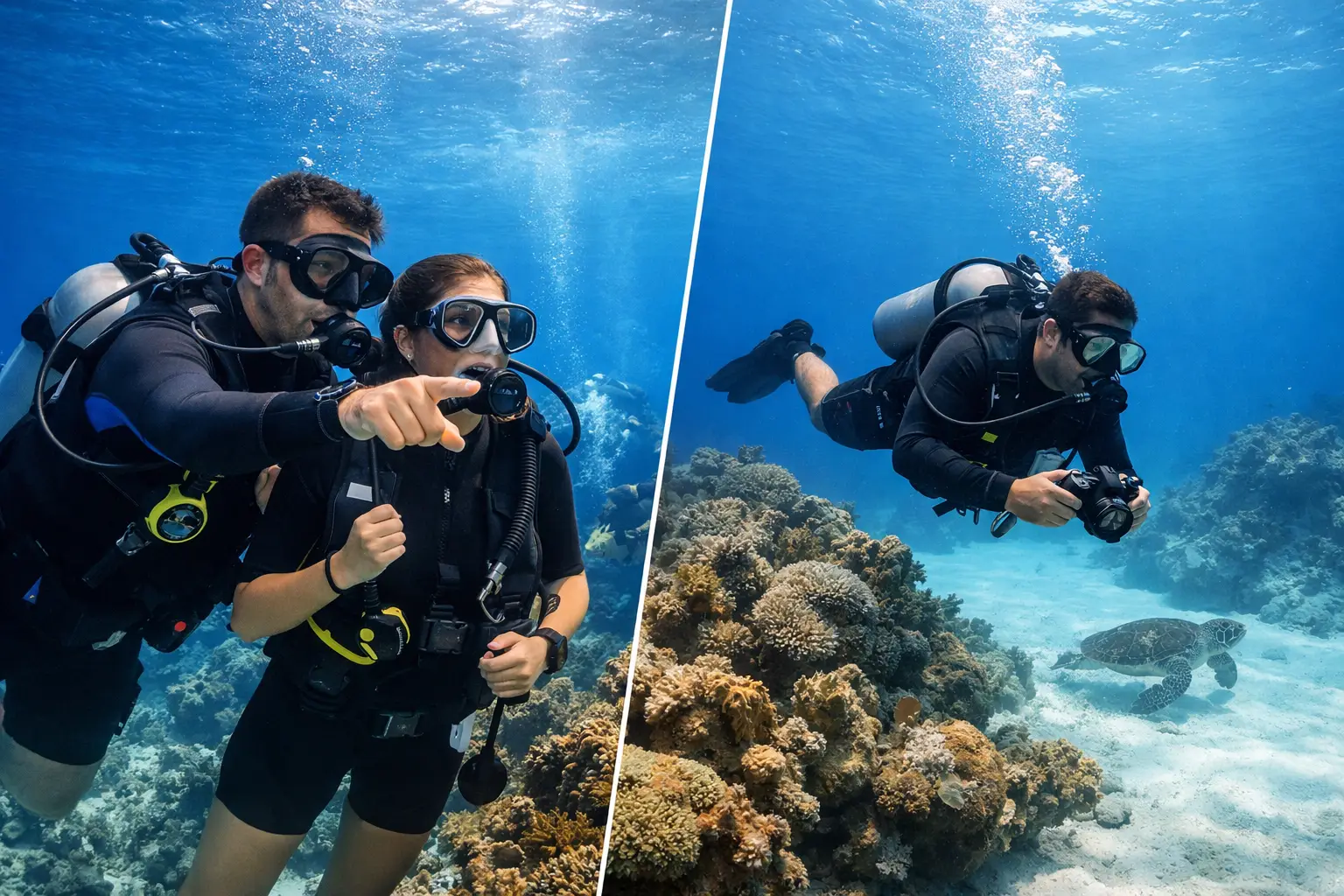
A guided dive is led by a qualified dive professional who knows the site, monitors the group, and helps shape the experience around conditions and diver ability. On a boat dive, that usually also means support with gear setup, entry and exit procedures, briefings, surface intervals, and the practical details that can feel surprisingly demanding when you are away from home.
Self-guided diving gives certified buddies more control. You and your partner plan the profile, choose how long to remain at each feature, manage gas and navigation, and decide when to turn the dive. For experienced divers who know the location well, that freedom can be deeply rewarding.
The key distinction is not simply guide versus no guide. It is local knowledge and shared responsibility. A guide handles the site-specific decisions while you remain responsible for your own diving. In a self-guided setting, your buddy team carries both responsibilities from start to finish.
Why Local Knowledge Matters in Punta Cana
The waters near Bávaro and Punta Cana can look invitingly simple from the surface: bright sun, warm sea, and a coastline made for a beach day. Underwater conditions tell a more detailed story. Current direction, visibility, boat traffic, surge near shallow structure, and the best approach to a reef can change from one day to the next.
A local guide knows where a wall begins to drop away, where juvenile fish gather after a current shift, and which route makes sense when visibility is lower than expected. At a wreck such as St. George, that knowledge also affects how you experience the site. A guide can help you understand its layout, maintain an appropriate depth and time profile, and identify the marine life that has made the structure home.
This is especially valuable at sites with more moving parts. Shark encounters, deeper walls, caves, cenotes, and wrecks are not places to treat as a casual extension of a beach swim. They can be extraordinary experiences, but they reward good judgment, careful planning, and respect for training limits.
When Guided Diving Is the Better Choice
Guided diving is often the clearest choice for first-time visitors to a destination, even if they are confident certified divers. You get to spend more of the day observing and less of it wondering whether the reef is in the right direction or whether the boat pickup has moved with the current.
It is also the strongest option for newer divers. A guide can set a relaxed pace, assist with buoyancy reminders, point out creatures you might otherwise miss, and make the experience feel calm rather than technical. That does not mean the guide replaces your buddy or your certification requirements. It means you have an experienced professional adding another layer of awareness.
Families, couples, and private groups often appreciate guided diving for a different reason: everyone can enjoy the same adventure without one person becoming the unofficial trip manager. Gear, transport, timing, and site briefings are handled with care, leaving more room for the moments people came for - a sea turtle crossing the reef, a school of blue tangs turning in the sunlight, or the quiet thrill of descending together.
At Scuba & Chill, groups are limited to four divers. That smaller format matters. It is easier for an instructor to adapt the pace, offer individual attention, and avoid the rushed feeling that can come with a crowded boat. For divers who value a personal experience, this is not just a comfort detail. It is part of diving well.
A Guide Helps You See More, Not Just Stay on Course
The best guides do not race ahead with a pointer. They read the group and the reef. They know when to pause at a coral head, where to look for camouflaged scorpionfish, and how to approach marine life without disturbing it.
This can change the character of a dive. Self-guided divers may cover the same distance, but a guided group often comes away with a richer sense of what they saw and why it belongs there. That is particularly meaningful in a region where healthy reef habits, coral restoration awareness, and respectful wildlife encounters matter.
When Self-Guided Diving Makes Sense
Self-guided diving can be an excellent fit for experienced, self-reliant buddy teams at locations designed for it. The best candidates are divers who are comfortable with shore entries, compass navigation, gas planning, emergency procedures, and making conservative calls when conditions do not match the original plan.
It works best when the site is familiar or clearly laid out, access is permitted, and there is a dependable plan for support and exit. A calm, uncomplicated shore dive is very different from navigating a new offshore reef from a boat. The latter can require local authorization, knowledge of moorings and currents, and coordination that is simply not available to independent visitors.
Self-guided diving may also appeal to underwater photographers who want long, patient encounters with one subject. If your buddy team communicates well and the conditions are appropriate, having full control over your pace can be a real advantage.
Still, independence has a cost. You may need to arrange transport, tanks, weights, equipment, access, and emergency planning yourself. You will also need to accept that a site you imagined visiting may not be suitable that day. The most experienced divers are often the quickest to cancel or change plans when conditions call for it.
Compare the Experience Before You Book
A guided dive usually offers more convenience, particularly on vacation. Transport from Bávaro, complete equipment, a certified professional, and a site plan remove several small friction points that add up quickly. It can also be a better value than it first appears when you consider what independent diving requires you to organize.
Self-guided diving may appear less expensive if you already have your equipment and access to a suitable site. But price should not be the only comparison. Ask what is included, who is monitoring conditions, how the boat pickup works, what emergency oxygen and first aid provisions are present, and whether the operation limits group size.
For advanced divers, the question becomes more specific. Are you looking for maximum autonomy, or are you looking for access to the best parts of a destination? A local guide can often make a demanding site more enjoyable without making it feel restrictive. You still control your buoyancy, gas, comfort level, and decision to end a dive. The guide brings the route, timing, and regional perspective.
Choose by Confidence, Not Ego
There is no prize for choosing the most independent-looking option. A sensible diver chooses the format that matches the conditions and their current skills, not the number of dives recorded in their logbook.
Before deciding, consider a few honest questions. Have you navigated in current recently? Are you comfortable setting up unfamiliar rental equipment? Do you know the local procedures and emergency resources? Is your buddy equally prepared, and do you communicate clearly underwater? If any answer is uncertain, guided diving is likely the more relaxed and responsible path.
A guided experience is also a smart way to learn a destination before returning for more independent exploration elsewhere. You can observe how the site is approached, ask questions after the dive, and build a clearer picture of the local environment. That is not giving up freedom. It is using good information to make future choices better.
The Caribbean is at its best when you have enough confidence to slow down: breathe steadily, look beneath the ledges, and let the reef reveal itself. Choose the support that lets you do exactly that.
Want to dive in the Dominican Republic?
Tell us your level, dates and what kind of experience you want. We will help you choose a dive, course or excursion.
Talk on WhatsApp